

What is a DECT handset?

A DECT handset is part of a cordless telephone system designed for reliable, private wireless communication. These are commonly used in offices, healthcare facilities, and other busy workplace environments where the staff needs to stay connected without being tied to a desk.
Functionality
How do DECT devices work?
DECT devices operate by wirelessly connecting to an access point or base station through digital radio signals. This gives you clear voice quality and the freedom to move around within the coverage area.
Radio frequency and time division
DECT uses dedicated interference-free radio frequencies (1,880–1,900 MHz in Europe, Africa, Asia, Australia, Middle East and South America, 1,920-1,930 MHz in North America and 1,910-1930 MHz in Latin America) and time-division multiple access (TDMA) technology. This means disturbance from other technologies is limited to nearly non-existing and each conversation gets a specific time slot and frequency. This reduces interference and guarantees call quality even when multiple devices operate nearby.
Range and handover
A standard DECT system offers a range of up to 50 meters indoors and up to 300 meters outdoors from the base station. In larger coverage areas, additional base stations can easily be added to expand coverage and let calls continue smoothly as you walk between zones. DECT is preferred in applications where reliable wireless functionality is required, for example in personal alarm applications, people monitoring or machine monitoring system applications.
Security and encryption
Calls through DECT handsets are digitally encrypted to protect conversations from interception. Each handset authenticates with its base, meaning only registered devices can join the network. Modern DECT solutions comply with strict security standards to minimize the risks for eavesdropping.
Pros and cons of using DECT devices
As mentioned, these devices are designed to meet the needs of modern workplaces with a range of features that enhance communication and flexibility. While they offer many advantages, it’s also important to consider a few practical limitations when choosing the right solution.
Benefits
DECT handsets provide many useful features. Some of the primary benefits are:
- Secure communication with digital encryption and authentication.
- Excellent mobility and range for staff on the move.
- Flexible expansion with multiple handsets, base stations, and integrations such as alarm or messaging systems.
- High voice quality and reliability in demanding environments.
- Protected and interference-free radio frequencies, globally dedicated for DECT.
Limitations
Despite their advantages, DECT systems have certain constraints that may affect their suitability for some settings:
- Coverage is limited to the area around the base station(s); larger sites require additional base stations and infrastructure.
- DECT is excellent for voice, alarms and messaging but not suitable for larger data transfer. For example DECT is not the right technology for internet browsing or file transfer.
- Vendors often provide very long product lifetime but there is a limited selection of device variants.

Do you need a license to use DECT devices?
In most countries globally, DECT operates in license-exempt frequency bands (1,880-1900MHz in EU/EFTA, AU), which means no individual license is required for personal or business use.
Comparison
How does a DECT handset differ from a regular phone?
Landline, cellular vs. wireless communication
Regular phones rely on a fixed landline or mobile network, while DECT phones use a secure, short-range radio link between a handset and base station. That means you can move freely around the office and use multiple handsets without the interference common to analog systems. The connectivity to the mobile network is dependent on the mobile operator while DECT is usually deployed and owned by the end-users organisation. This guarantees coverage and uninterrupted functionality between users and between monitoring systems and the users.
Quality and interference resistance
DECT systems are engineered for clear voice communication with minimal interference, even in environments with heavy wireless traffic, unlike older cordless models or analog phones which can suffer from noise or dropouts. DECT uses circuit switched technology which maintains a continuous voice channel. This differs from packet switched technology that is used in Wireless LAN and mobile networks that degrades based on call density, use of older devices and is prone to radio interference. This interference is due to the vast number of various devices coexisting on the same 2.4 & 5 GHz frequency range.
Features and expandability
Most DECT systems support advanced features such as call transfer, conferencing, paging, emergency alarms, and the ability to add multiple handsets or integrate with PBX, which makes them scalable over time. Regular phones often lack these capabilities.
Our products
COBS DECT systems
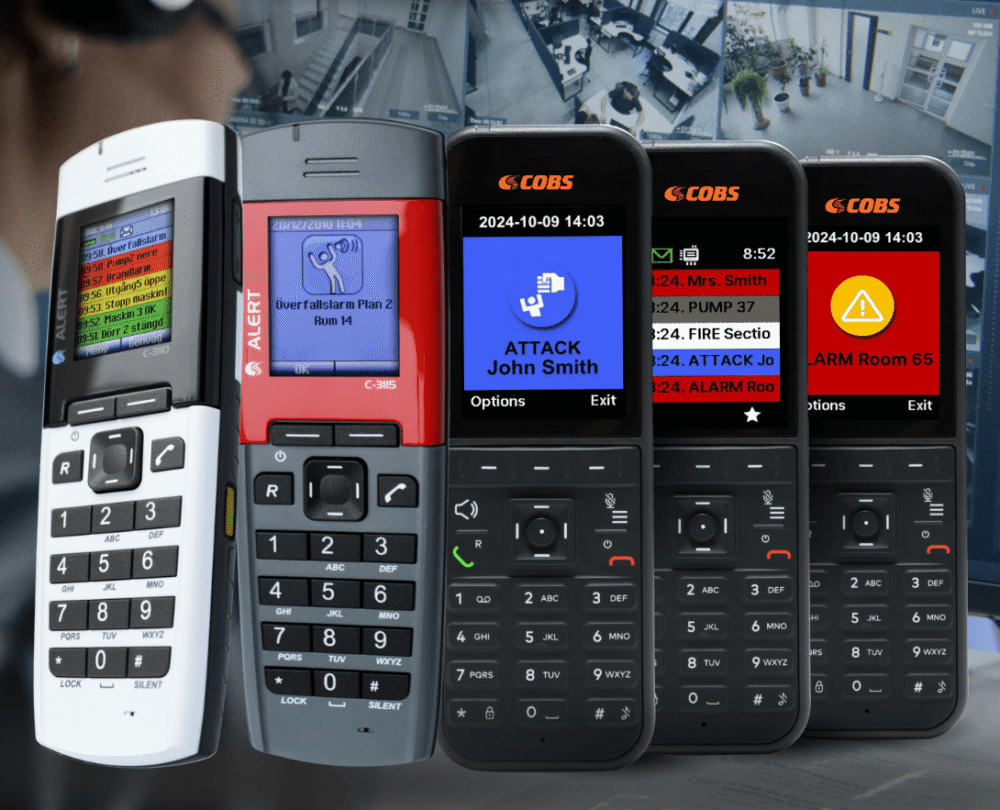
In our catalogue, you’ll find a variety of DECT systems tailored to meet the needs of numerous businesses.
Our solutions include high-quality handsets, robust infrastructure components, and base station accessories designed for seamless integration and reliable performance.
Frequently asked questions
-
What is DECT?
-
What does NG-DECT and CAT-iq mean?
-
What does NR+ mean and how is it related to DECT?
-
Is DECT safe from eavesdropping?

Ready to improve your communication?
At COBS, we craft resilient, high-performance communication systems designed to thrive in challenging workspaces. Reach out to learn more about wireless technologies for voice, critical messaging and alarm applications for your business needs.